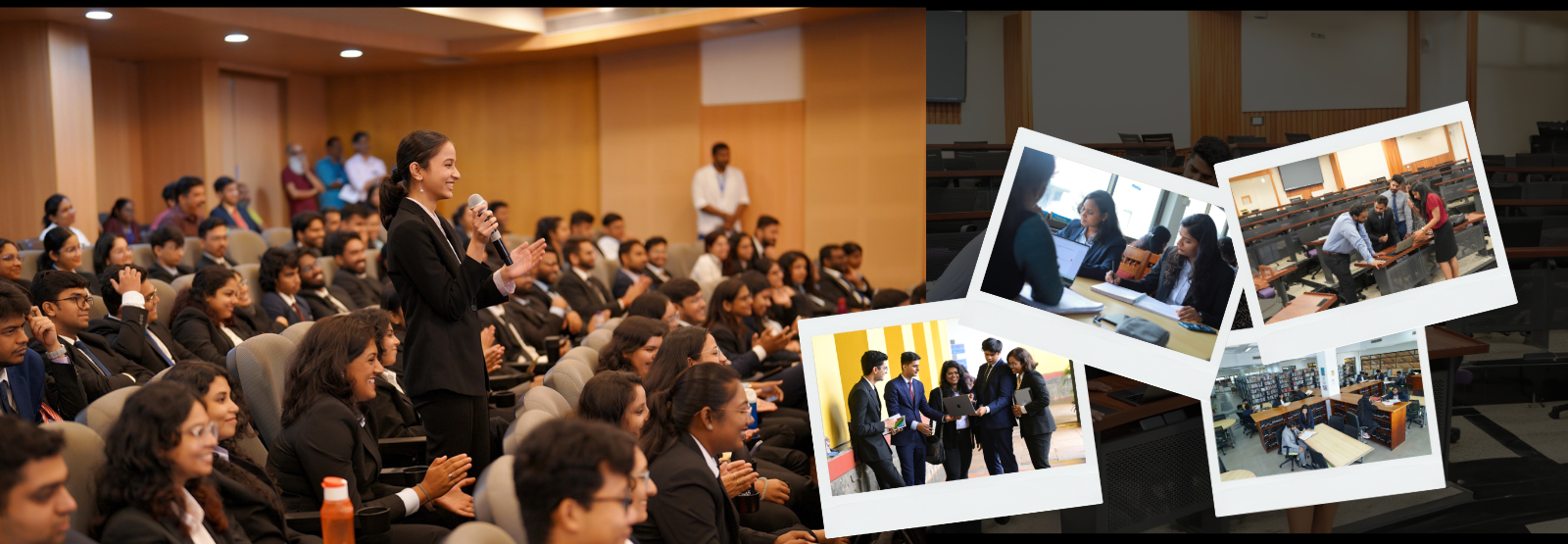
The Bachelor of Management Studies (BMS) is a Four Year–Eight Semester programme, that offers a major in Management and options to pursue minor in multiple areas like Economics and Public Policy, Artificial Intelligence and Machine Learning, Psychology and Behavioural Sciences, Finance and Big Data, Liberal Studies in Management and Marketing, Sales and Digital Promotion. The Programme is organised on the basis of credits which is the fundamental unit of study in this programme. A credit represents the workload of a course, measured by the weekly hours of instruction during a semester. One credit is equivalent to one hour of classroom instruction per week in a semester. A four-credit course will therefore have a minimum of 4 hours of classroom instruction every week, throughout the semester. The students are expected to spend at least 2 hours for preparation (before and after the class) for every hour of class room engagement.
A semester will be for a minimum of 15 weeks. In a year, there will be two semesters. The odd/fall semester (Semesters 1, 3 , 5 and 7) will commence in August and continue till December. After a brief semester break, the Even /Spring semester (Semesters 2, 4 , 6, and 8) will begin in January and continue till May.
The summer break will be from May to August every year. The students may opt for internships in organisations, research projects with faculty or pursue extra credits by taking up courses offered in summer terms (Usually 2 credits).
Upon successful completion of the four-year programme, a student shall be awarded the Bachelor of Management Studies (Honours) degree. Students may also opt to undertake a research project under the guidance of a faculty member of the Institute. Those who successfully fulfil the prescribed research requirements shall be awarded the Bachelor of Management Studies (Honours with Research) degree. Both degrees shall be conferred in accordance with the stipulated credit requirements and the applicable institutional regulations. The courses offered under the programme are organised into three distinct categories.
Foundation Courses: These courses enable the students to develop a deep comprehension of basic skills and knowledge in those areas which are essential in developing further mastery in management. Foundation courses include Economics, Quantitative Methods, English, Accounting, Computing, Psychology, Sociology, Law etc.
Core Courses: These courses pertain to the major area of study which is Management Studies. Students are expected to complete the equivalent of 80 credits of instruction in this area (20-24 courses) in various subjects like Finance, Accounting, Organisational Behaviour, Marketing Management, Human Resource Management, Strategy, Operations Management, Supply Chain Management, etc. The depth of coverage will exceed the typical curriculum up to the first year of a two-year MBA Programme, and students will be equipped to take up most entry-level roles in business and management.
Elective Courses: The elective courses relate to areas of specialization corresponding to the areas of minor chosen by the students. A student must choose at least one minor area. Each minor area should have at least 40 credits (10-12 courses). Elective courses will be available in each area of the minor and will be offered based on student interests. The Institute will make available a list of elective courses in each semester in the third and fourth year and the students will have to bid for the courses of their interest. The availability of a minor or an elective course depend on a mandatory minimum number of students showing interest in the subject.
|
Semester 1 |
Credits |
|
Semester 2 |
Credits |
|
|
|
Business and Management |
4 |
|
Creating and Managing Customers |
4 |
|
|
|
Poetry and Literature |
4 |
|
The Art of Mathematics |
4 |
|
|
|
Fundamentals of Economic Analysis |
4 |
|
Brain, Mind, and Consciousness |
4 |
|
|
|
Sociology and Anthropology |
4 |
|
Computation and Artificial Intelligence |
4 |
|
|
|
Introduction to Accounting and Finance |
4 |
|
Management Accounting |
4 |
|
|
|
Yoga Asana and Pranayama |
2 |
|
Functional Language 1 |
2 |
|
|
|
Computing in Practice |
2 |
|
Yoga and Mindfulness Meditation |
2 |
|
|
|
Total |
24 |
|
Total |
24 |
|
|
|
|
|
|
|
|
|
|
|
Semester 3 |
Credits |
|
Semester 4 |
Credits |
|
|
|
Algorithmic Thinking and the Art of Programming |
4 |
|
Indian Economic and Political History |
4 |
|
|
|
Introduction to Law |
4 |
|
Social Psychology |
4 |
|
|
|
World and Indian History |
4 |
|
Philosophy across Cultures |
4 |
|
|
|
Mathematical Optimization |
4 |
|
Introduction to Mathematical Statistics |
4 |
|
|
|
Organisational Behaviour |
4 |
|
Human Resource Management |
4 |
|
|
|
Community Project |
2 |
|
Responsible Citizenship |
2 |
|
|
|
Foreign Language and Culture |
2 |
|
Personal Finance |
2 |
|
|
|
Total |
24 |
|
Total |
24 |
|
|
|
|
|
|
|
|
|
|
|
Semester 5 |
Credits |
|
Semester 6 |
Credits |
|
|
|
Strategic Management |
4 |
|
Institutions and Economic Growth |
4 |
|
|
|
Operations and Supply Chain Management |
4 |
|
Leadership |
4 |
|
|
|
Sustainability and Business |
4 |
|
Project Management |
4 |
|
|
|
Financial Markets |
4 |
|
Corporate Finance |
4 |
|
|
|
Price Theory |
4 |
|
Innovation and Design Thinking |
4 |
|
|
|
Business Communication 1 |
2 |
|
Business Communication 2 |
2 |
|
|
|
Appreciation of Music/Art |
2 |
|
Appreciation of Cooking/Carpentry/Weaving |
2 |
|
|
|
Total |
24 |
|
Total |
24 |
|
|
|
|
|
|
|
|
|
|
|
Semester 7 |
Credits |
|
Semester 8 |
Credits |
|
|
|
Elective/Minor 1 |
4 |
|
Elective/Minor 1 |
4 |
|
|
|
Elective/Minor 2 |
4 |
|
Elective/Minor 2 |
4 |
|
|
|
Elective/Minor 3 |
4 |
|
Elective/Minor 3 |
4 |
|
|
|
Elective/Minor 4 |
4 |
|
Elective/Minor 4 |
4 |
|
|
|
Elective/Minor 5 |
4 |
|
Elective/Minor 5 |
4 |
|
|
|
Elective/Minor 6 |
4 |
|
Elective/Minor 6 |
4 |
|
|
|
Internship* |
4 |
|
Research (Dissertation)** |
12 |
|
|
|
Total |
24 |
|
Total |
24 |
|
|
|
||||||





IIMK Campus P. O, Kozhikode, Kerala, India,
PIN - 673 570